01 / 0:59
Lanterns on the Dock
Marimba, light syncopation and a melody opening towards the sea.
Download WAVDownload MIDI EN ROUTE TO THE CARIBBEAN · SINCE 1999
Twelve original themes. Four places. The adventure changes its music with you.
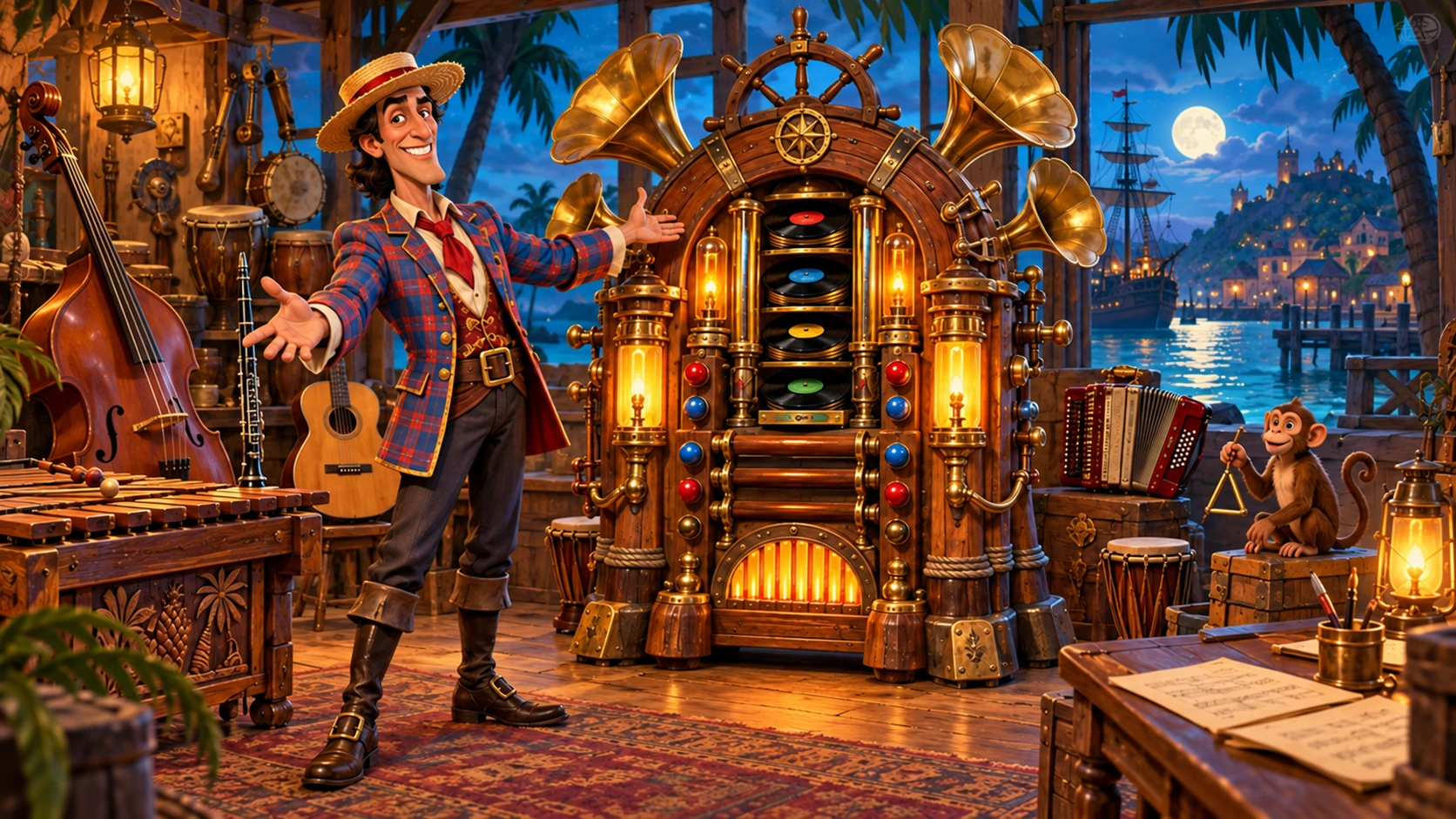
Come in: Stan has found a way to sell you the same tune four times. This time, you really will hear the difference. Dock, tavern, lagoon and ship change the instruments and colour while the musical thread keeps moving.
This tribute to iMUSE is something to hear and play. Twelve original miniatures offer forty-eight starting arrangements. Mix five parts, change the pace and write eight bars of melody. The music was composed for this workshop and uses synthesised timbres, not LucasArts recordings or reconstructions.
“An orchestra that follows you? Sold. You’re the conductor, though.” — Our imaginary Stan
01 / iMUSE LAB
Choose a theme and press Play. A new place enters at the next bar; a new theme or tempo waits for a four-bar phrase, with a short bridge. The comparison mode deliberately switches immediately.
Ready to sail

The musical harbour: four imaginary places, four ways to tell the same melody.
The shop is open. Choose a theme and press Play; nothing plays automatically.
02 / Stan’s twelve records
Each piece has its own melody and harmonic sequence. Hear a finished version or take it into the walk and change its arrangement. Audio files load only when you listen.
WAV recordings visit three arrangements; MIDI files contain the editable eight-bar phrase.
01 / 0:59
Marimba, light syncopation and a melody opening towards the sea.
Download WAVDownload MIDI02 / 0:51
A clarinet smile, bouncing chords and a bargaining step.
Download WAVDownload MIDI03 / 1:16
Sparse notes, soft bells and room to breathe.
Download WAVDownload MIDI04 / 0:55
Plucked strings and a gentle push towards the horizon.
Download WAVDownload MIDI05 / 1:07
Dorian colours and questions between the notes.
Download WAVDownload MIDI06 / 0:50
A lively theme with short replies and light percussion.
Download WAVDownload MIDI07 / 1:12
A descending line that seeks the light again.
Download WAVDownload MIDI08 / 0:57
A curious melody ready to find another route.
Download WAVDownload MIDI09 / 1:02
A little chase between calls and countermelody.
Download WAVDownload MIDI10 / 1:18
A bright ballad with long notes and silences.
Download WAVDownload MIDI11 / 0:48
The quickest race in the catalogue, still smiling.
Download WAVDownload MIDI12 / 1:06
A major-key farewell with time to set sail again.
Download WAVDownload MIDI03 / Compose your own route
Each column is an eighth note; each screen is one 4/4 bar. Tap a cell to add a note, then again for silence. Eight bars make your loop, with bass, chords and rhythm arranged by the jukebox.
Bar 1/8
Notes rise from bottom to top. Arrow keys and Enter also work. Copying adapts a theme to the editor’s eight notes. An idea from Stan replaces all eight bars with an editable suggestion. Undo restores the previous version.
Saving uses this browser only; nothing is sent to the site. Export JSON to keep a portable copy. Restoring or importing does not start playback.
WAV and MIDI export the editor melody with the currently selected place, tempo, swing and five mix levels. WAV contains one loop and a tail; MIDI contains notes and may sound different in your software. Playback pauses during WAV rendering.
04 / iMUSE
Try before defining it: bring the melody forward, enter the tavern and listen to its changing surroundings. Identity can remain recognisable while context changes. This is a small lesson in musical direction.
01
Our dock favours marimba and strings; the tavern brings clarinet and accordion; the lagoon opens into bells and strings; the ship adds rhythmic drive. Remove the countermelody, then the bass: a place is also shaped by what stays silent.
02
An arrangement waits for a bar; theme and tempo wait for a four-bar phrase with a short bridge. Toggle Musical transitions to compare this with an intentional immediate cut.
03
Land initiated the idea and developed the system with McConnell, who identifies Monkey Island 2 as its first game in his Game Informer interview.
Peter McConnell / Matt Helgeson · Game Informer · 12 February 2013 ↗04
In 2010 McConnell distinguishes parallel parts from movement through the timeline, describing precomposed transitions synchronised to beats and bars. Try mixing the five parts, then changing themes.
Peter McConnell / Dren McDonald · Game Audio Network Guild · 21 November 2010 ↗05
The patent describes sequences and decision points responding to unpredictable events. Filed on 25 November 1991, US patent 5,315,057 was granted on 24 May 1994.
Michael Z. Land, Peter N. McConnell · US 5,315,057 · 24 May 1994 · PDF ↗06
This workshop has its own synthetic orchestra and musical rules. It runs neither iMUSE code nor LucasArts files. McConnell’s Lucasdelirium interview also discusses the move to digital music and the balance of performance and flexibility.
Peter McConnell / Lucasdelirium · Interview ↗The idea is not simply to play more instruments. It is to connect listening to the player’s actions, including pauses and delays that a fixed sequence cannot predict. A voice can remain while another responds.
In the VGMO interview, McConnell describes a loop between game, music and listener. Try moving because of what you hear, rather than treating sound only as a consequence of clicking.
Our marimba, nylon-string, clarinet, accordion, strings and percussion timbres are synthesised, not recordings of performers. Twelve finished versions are available alongside the interactive arrangements. Music and sounds remains the route to the historical game music.
Melodies and arrangements created for the site with the assistance of artificial intelligence and performed using synthesized instruments.