 EN ROUTE TO THE CARIBBEAN · SINCE 1999
01Your action
02The script responds
03The world changes
A name born in a mansion
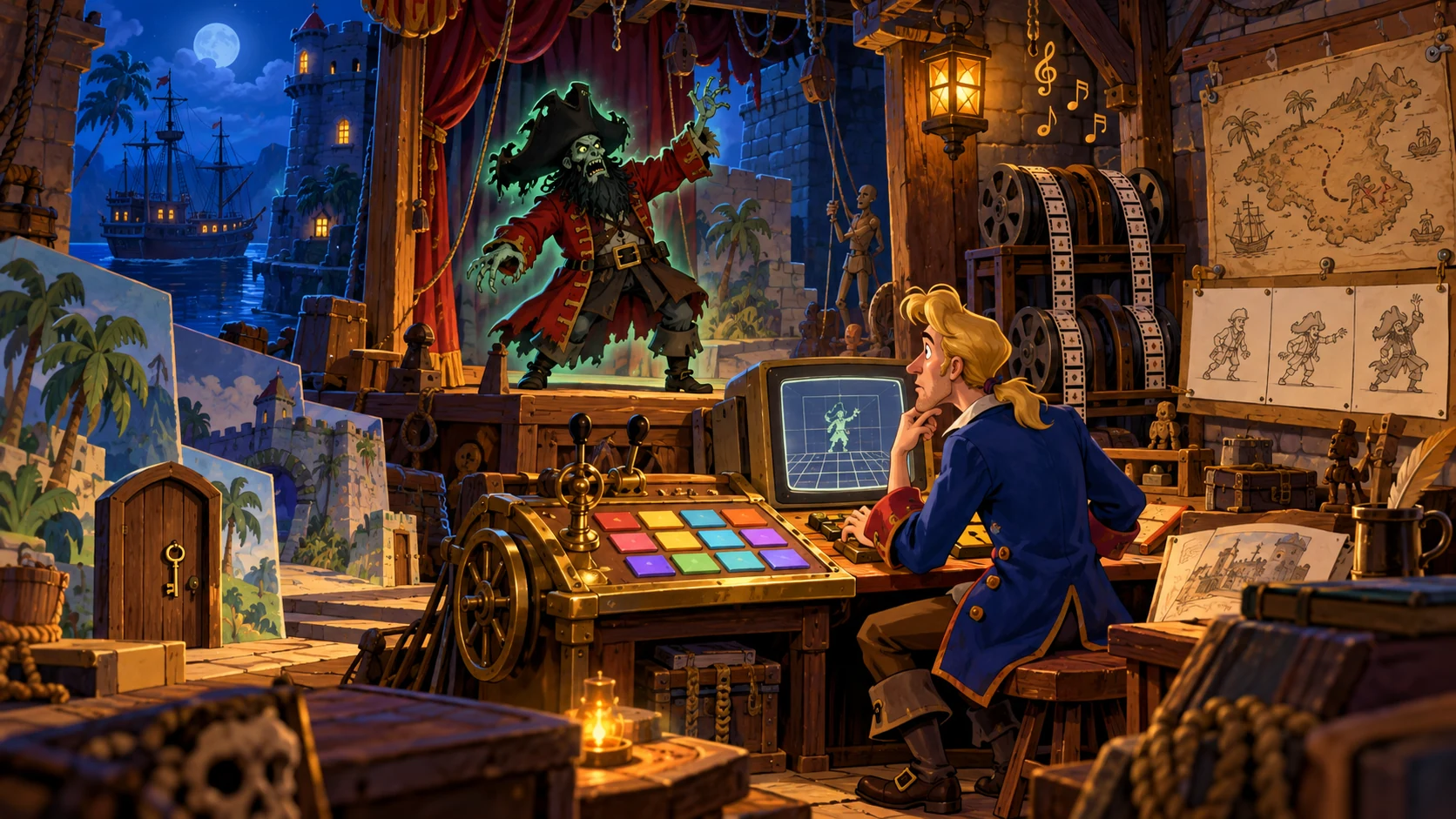
SCUMM stands for Script Creation Utility for Maniac Mansion. Created for Maniac Mansion in 1987 by Ron Gilbert and Aric Wilmunder, it let authors describe scenes and behaviour without rebuilding the whole game engine. The engine carried out the instructions: who enters a room, what somebody says and when an object changes state.
Verbs and inventory: a grammar for curiosity
Open, look, pick up, use: commands turn a player’s idea into a request to the world. Inventory holds objects and possibilities. A door can be closed, open or locked; actions produce different replies. Authors must define what happens when objects are combined.
The stage keeps moving
As Guybrush walks, another actor can animate, dialogue can appear and a scene can progress. Scripts coordinate actions that appear simultaneous. Backgrounds and movement paths suggest depth; animations and interactive objects make a room feel alive.
One door, one key, three verbs
Try looking, picking up and using. This small model illustrates actions, inventory and world state; it does not run original SCUMM code.
Locked door
Empty inventory
A locked door. A key on the table.
SCUMM does not mean one interface
The system evolved. Loom builds interaction around musical notes and drafts; Full Throttle and Curse use contextual actions rather than a long row of verbs. Different interfaces still interpret actions and world states.
Music follows your footsteps
Michael Land and Peter McConnell’s iMUSE makes music respond to the game. Monkey Island 2’s Woodtick transitions are a famous example: the accompaniment changes with the location rather than simply stopping and restarting. iMUSE is a music system, not another name for SCUMM.
SCUMM, GrimE and ScummVM are different
Grim Fandango and Escape from Monkey Island use GrimE, a different engine associated with Lua and 3D characters. ScummVM reimplements many engines so their game data can run on other systems. It is not the old LucasArts editor and does not automatically include the games.