 EN ROUTE TO THE CARIBBEAN · SINCE 1999
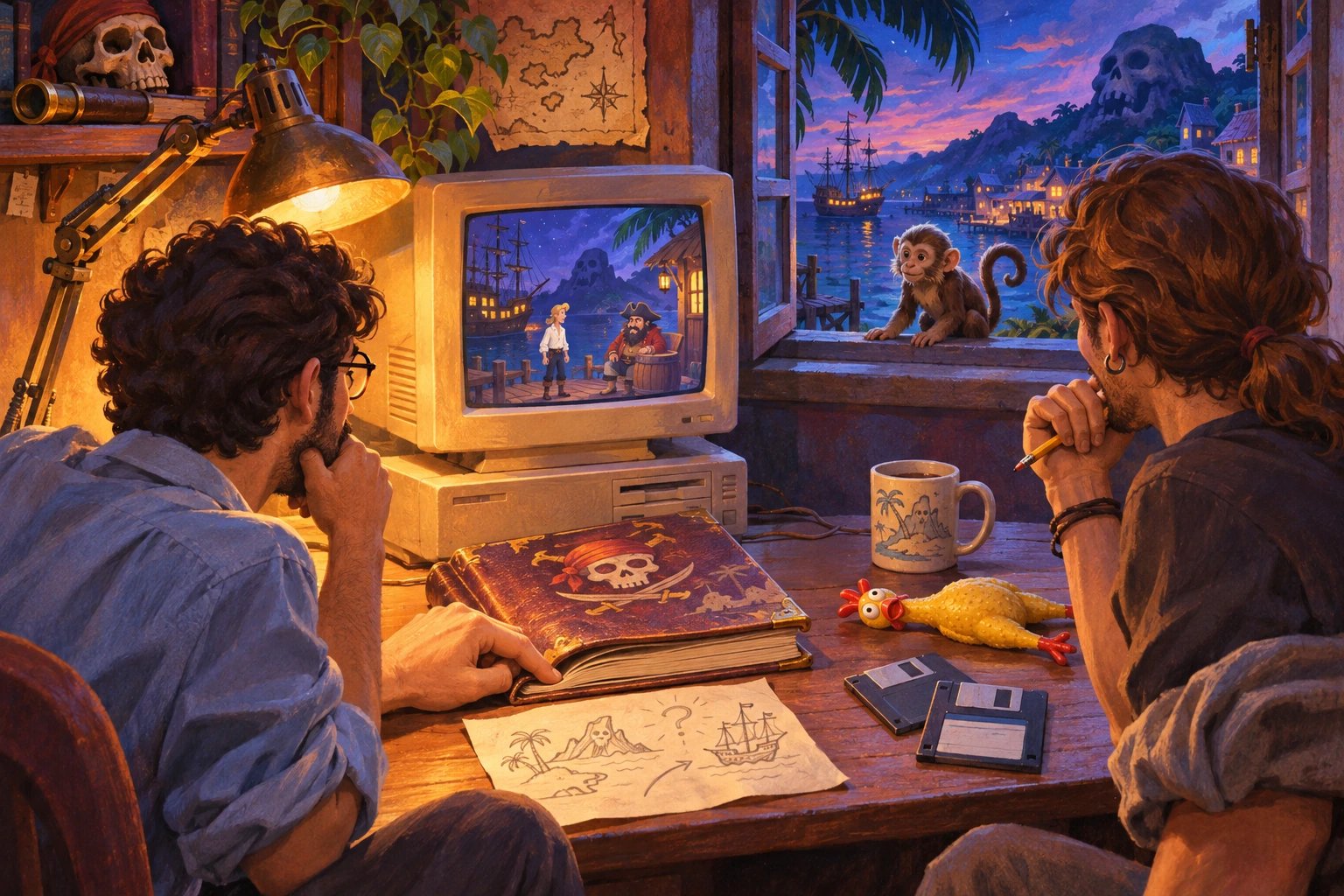
Some games keep running after you switch off the computer. They no longer occupy the screen, but they hold on to a little space in your head. A door to open, a character who refuses to cooperate, an object picked up who knows where whose purpose, naturally, remains a mystery. Except that you are certain it will be useful eventually. Why else carry half a hardware shop and a rubber chicken?
Graphic adventures could do that too: accompany us outside the game. You could be stuck in the same place and still keep travelling, looking for a connection between two details or reconsidering a line that initially sounded like a joke. Imagination carried on working while Guybrush patiently waited beside his problem. He did, after all, have fewer commitments than we did.
Looking back now, I think some of their magic lived in that interval between question and answer.
Then came the moment of comparing notes with friends. ‘Did you manage to get past it?’ could start discussions far more animated than certain school lessons. Attempts, intuitions and theories were pooled, some of which deserved checking before anyone said them aloud. But one ‘I think I’ve got it’ was enough to make you want to switch the computer on again.
That was part of the adventure too. The answer arrived with a voice, a meeting, the satisfaction of returning the favour when, a few screens later, your friend needed help.
Sometimes we waited, even for months, for a solution or a little help to appear in one of the wonderfully lively gaming magazines that crowded the newsstands of the 1990s — without the slightest restraint.
The colourful covers, the screenshots between paragraphs, the story accompanying the voyage: even help was something you could hold. A magazine or a little book beside the mouse, opened rather cautiously, because your eyes were very good at reading the next answer too. Precisely the one you had promised yourself not to look at.
Of course, remembering only the romantic side would be convenient. The impossible puzzles might turn up asking for an explanation…
The infamous monkey wrench from the second Monkey Island is a good candidate. Without giving away its solution here, part of the reasoning depends on English wordplay. Without that linguistic connection, you can examine every detail and listen to every conversation without seeing a way forward. Patience alone does not provide an extra dictionary.
In such cases, discovering the answer can leave you feeling something quite unlike satisfaction. Instead of ‘Of course, I could have worked that out’, you wonder how you were supposed to imagine anything like it. You may even give Guybrush a stern look, despite knowing the poor fellow was only following orders.
It is a fine boundary, but it matters. A good puzzle gives you enough room to lose your way and enough clues to find it again. When the pieces finally fit, the surprise seems to belong to the player too. You recognise something that was right in front of you and suddenly makes sense. It is a small achievement, and some small achievements stay with us for decades.
When an essential step is missing, however, waiting can wear away the pleasure of travelling. Even a tavern full of pirates, after the twentieth visit without a new idea, can start to resemble a waiting room.
That is why I would never rank people according to whether they finished Monkey Island without help or consulted a guide. These days, many of us must win ourselves the time to play as well. Between work, family and days that end before the to-do list does, a free evening is already a little treasure. Turning it into an endurance test to prove our devotion would be rather odd.
A hint can be enough to set curiosity moving again. Sometimes it restores the desire to search that being stuck had taken away. If someone prefers to read a solution and carry on with the story, I wish them a good voyage all the same. Enjoying those conversations, revisiting those places and smiling whenever Stan appears is no less genuine.
As for me, I still like leaving a little room for doubt. Looking again, trying an unpromising idea, giving a detail time to become important. Perhaps because those attempts bring back something of the days when these worlds were new and we still had so much to discover.
We cannot recover exactly the time we had then. But now and again we can rediscover that willingness to be intrigued. Perhaps with someone to share a theory, a joke or a ‘wait, try this’.
The solution can wait a little longer.
And if it really will not come, let us open the book. Keeping a finger over the next answer: some old tricks deserve to be preserved.
Alfnet