 EN ROUTE TO THE CARIBBEAN · SINCE 1999
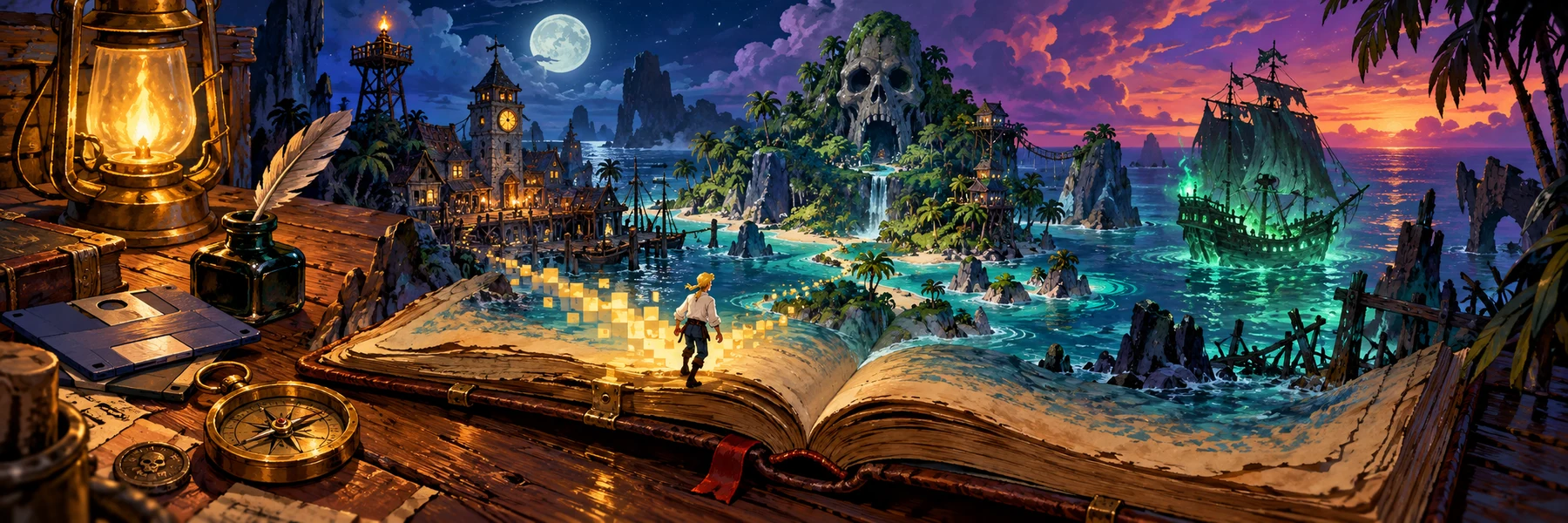
From a pirate dream to six adventures
The journey begins in 1990 with The Secret of Monkey Island and continues with LeChuck's Revenge, The Curse, Escape, Tales and Return. The two Special Editions propose the first chapters with a renewed look, while Monkey Island Madness belongs to the collections.
 Hey Pirates!
Once upon a time, pronouncing the words "Monkey Island" would have been enough to outline the contours of the most beloved videogame saga of all time. But, unfortunately, time has passed and to keep the memory alive it is necessary to waste a few more words to introduce the visitor to this site into a world full of magic and charm, linked to a computer game whose first episode dates back to 1990.
And here, then, a bit of history.
The generic name of "Monkey Island" refers to the well-known series of graphic adventures produced by LucasArts and created by Ron Gilbert with the significant contribution of Michael Land in the music and Steve Purcell in the graphics.
The first cycle of four chapters includes: The Secret of Monkey Island, Monkey Island II: LeChuck's Revenge, The Curse of Monkey Island and Escape from Monkey Island. The last two episodes, however, do not list the creator Ron Gilbert among the credits and for this reason, according to some, the second episode should be considered as the unofficial end of the saga. In fact, from the point of view of style, continuity and even era (the third chapter was developed 6 years after the second) it is not wrong to consider the games The Secret of Monkey Island and Monkey Island II: LeChuck's Revenge as a unique, well-defined and stand-alone work. These first two games saw the light of day on Amiga, IBM compatible and Apple Macintosh systems. Also taking into account their respective release eras, most consider Monkey Island II to be the most successful game of the series.
The series, as mentioned, was born in the early nineties, when the graphic adventure genre enjoyed great success among the gaming public. The comfortable interface they used allowed full control thanks to the use of the mouse alone: with it the player could explore rich and colorful environments, interact with various objects and even with other characters, choosing what to say with a click. The software that allowed all this was a famous LucasArts creation, the SCUMM development system, designed and already implemented by Ron Gilbert in previous adventures such as Maniac Mansion and Zak McKracken and the Alien Mindbenders, used here, in various and improved versions, up to the third chapter. The artistic side, curated by Steve Purcell, already revealed in the environmental deformations those caricatures which in future adventures will also refer to the characters, while still maintaining a strongly realistic style.
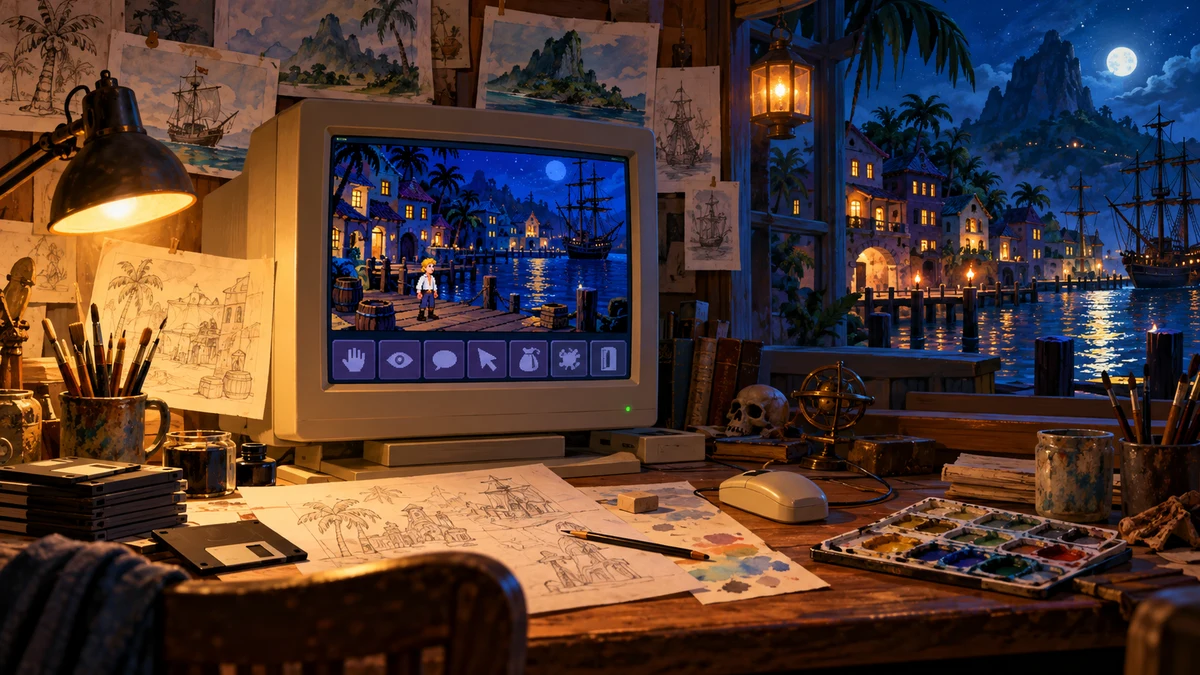
A central point in the development of the series is (as reported by LucasArts itself) the idea that a graphic adventure is a game, therefore that it should not fuel frustrations. During the various wanderings, the protagonist never risks dying and no player is forced to start over from scratch for having done (or not having done) something. Particular care has also been taken to avoid deadlock situations, in which the player finds himself unable to do/collect something because he has not previously done/collected something else. All this attention is aimed at making the gaming experience pleasant and relaxing and, contributing to identification, leaves the user with the only concern of solving the puzzles using all the clues scattered throughout the countless locations.
Although each Monkey Island adventure is divided into chapters, it is possible to recognize some similarities in the unfolding of the different episodes, similarities that lead back to a single narrative structure: background, preparation, journey, resolution. It is with this expedient that each new adventure is immediately familiar to the player and, although there are slight differences in the game interface, he quickly begins to move with ease within a plot that, even if unknown, does not disorientate.
Against all odds, and despite the efforts made in the production of the game, Escape from Monkey Island has sparked a lot of controversy, especially among long-time admirers who, having taken note of the undeniable merits of the product, have complained about shortcomings from many points of view, so much so that some of them do not even consider it worthy of the title of sequel. The reasons given are many, but they start from the assumption of a well-made software: the graphics of the new GrimE engine are light and fluid, the backdrops are splendid and refined even if they lack the detail achieved in the 2D period. The sound is undoubtedly the section that deserves the best rating: Mp3 compression, used for music and speech, allows you to enjoy CD quality audio, which is also expertly mixed during scene changes (note the muffled background sounds just outside the closed environments).
The criticisms arise from the analysis of the technical solutions and the subject. The gaming community has badly digested the abandonment of the mouse, which implies the death of point-and-click, and having to control Guybrush from the keyboard has made him more similar to Edward Carnby from Alone in the Dark. Not to mention that the adoption of polygonal graphics suddenly eliminated the expressiveness of the characters, an aspect for which the previous episode instead represents a peak in terms of detail and intensity.
Another controversial point was the inclusion of arcade sequences during the adventure, the technological "Monkey Kombat" which, far from entertaining as a parody, instead requires hours of learning: note that this type of arcade insert is already present in other successful graphic adventures (in Sam & Max Hit the Road or Indiana Jones and the fate of Atlantis) but rarely as an obstacle to overcome to continue the story, and never so challenging. The aspect that, according to many fans, is missing is the much-vaunted insult duels, a true distinctive element of the saga, an irresistible, exhilarating and innovative aspect present in the first and third episodes and present here in a marginal way (and the suspicion that Monkey Kombat was invented to replace them did not help the image of the game). Another absence is noted in the plot: too often one gets the impression that the game proceeds through mini-puzzles, without a general project but with filler pretexts, and the constant appearance of old characters to populate the islands, in a tacit self-incense of the old days, only confirms the sensation of a serious creative deficiency.
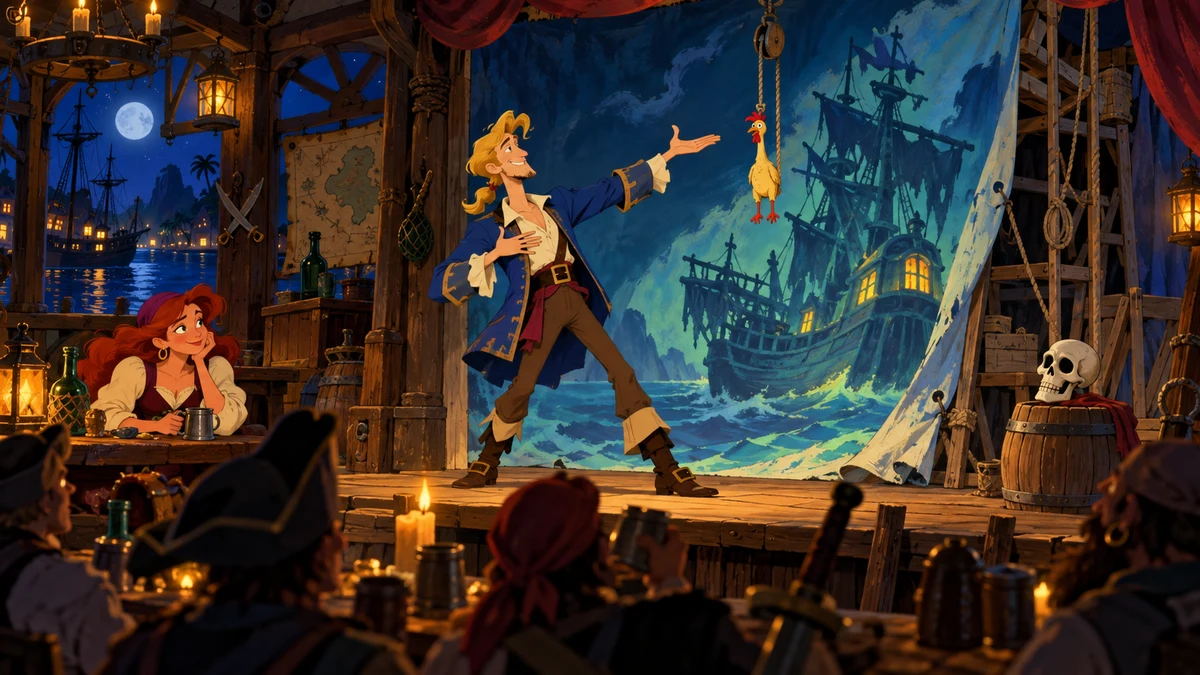
The true underlying theme of the saga is certainly humor (abundant, sometimes zany), and every episode is pervaded by it from the beginning to the happy ending. The programmers have deliberately hidden real gems within the games (Eastern Eggs), even numerous ones, which truly make them jewels of (self) irony: these are often more or less evident references to other creations of LucasArts itself (note the frequent appearances of the rabbit Max, thanks to Purcell, or the various objects belonging to Indiana Jones), or even particularly ridiculous and curious actions or phrases which are activated only in particular circumstances and with particular characters. Let's be clear, being able to find them is of no help in finishing the games sooner, but it is certainly fascinating to try to glimpse the light-hearted atmosphere that must have dominated the programmers' rooms.
One final piece of information concerns the distribution of all LucasArts games and, therefore, also of Monkey Island, which in Italy took place thanks to the now defunct CTO company.