 EN ROUTE TO THE CARIBBEAN · SINCE 1999
There are certain things in life that, although not included in the list of those epochal experiences that mark an existence, still manage to leave a probably indelible trace.
Specifically, especially for the current generation of thirty-year-olds, some memories are linked to the world of video games, and this for many reasons. Maybe it was because as kids we were witnesses of the dawn of that world of information technology which today, more than ever, punctuates everyday life. Maybe it's because the brilliant stories of some titles from a remote era, combined with the effervescent imagination of almost adolescents, gave emotions equal to those that epic tales unleashed in the audiences of antiquity. The fact is that having lived similar experiences today leads us to say, with a hint of pride: "Yes, I was there too!".
And saying "I was there too" is perhaps the expression that best summarizes that period of friends, summer adventures, football or subbuteo games and VIDEO GAMES, futuristic vehicles capable of transporting young minds into a parallel world, governed by different rules, all to be experimented with.
And while videogames "household items"marked the transition from arcade titles to those for home entertainment, titles that were true milestones of a distant period saw the light of day, among these the absolute legend was the Monkey Island saga. No PC game, in fact, has been capable of becoming a cult of a similar magnitude, so much so that, almost 20 years later, the interest does not seem to wane.
There was a time when saying words like: “There's a three-headed monkey behind you!” it would have been enough to make people understand that they were an "elected member" of the "gamers" clan, at least among gamers who are now at least twenty-five years old.
Today, probably, the same sentence would lead us, in the rosiest of hypotheses, to the couch of a good psychologist.
But what is the Monkey Island saga?
Easy. It was a video game produced by Lucas Arts (then known as Lucas Film Games), composed of the first four episodes, the first of which was released way back in 1990 with the title "The secret of Monkey Island”. The birth of this masterpiece is due to the creativity of Ron Gilbert, head of the project and father of the first two stories, who deliberately took inspiration from the well-known Disneyland ride "The Pirates of the Caribbean", as did the film producer Jerry Bruckheimer recently in the trilogy hits the box office which bears the same name as the attraction of the famous amusement park. It goes without saying that the dynamics of the story, between game and film, are in most circumstances similar (in the film cameos are scattered here and there).
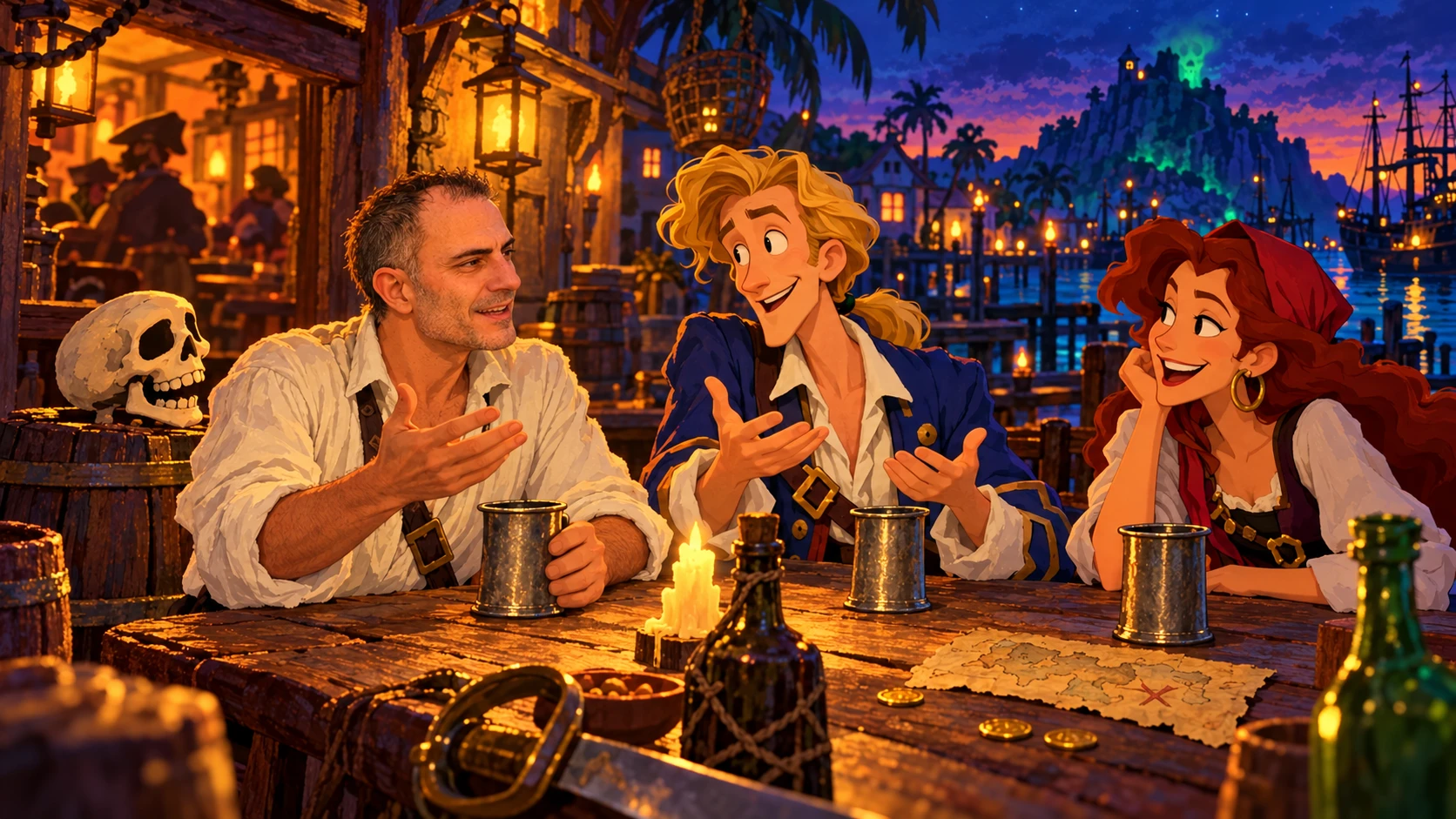
The plot had as its protagonist the unforgettable Guybrush Threepwood, an enterprising but somewhat awkward young man, with one big dream: to become a fearsome pirate. The events that made up the various episodes therefore narrated the adventures of Guybrush who, to reach his goal, found himself facing dangers of all kinds, from ghost pirates led by the legendary LeChuck (the protagonist's nemesis), through the fearsome cannibals who live on unexplored islands, up to sword duels against other buccaneers, the outcome of which depended on ridiculous offenses and related responses between the duelists.
Obviously the crux of the story was the romantic aspect linked to the figure of Elaine, a pirate governor, who made our hero lose his mind, willing to do anything to marry her.
The scene of the events was the Caribbean around a hypothetical 1700, even if the temporal and geographical aspects mattered little. The saga, in fact, is shaped completely on unbridled humor, without any control whatsoever, which often makes the scenography deliberately anachronistic and illogical for the pure sake of entertaining the player, managing to do so perfectly.
The story evolved in the first four episodes, not only as a plot, but also as a programming technique, especially considering that the fourth game (“Escape from Monkey Island”) was released in 2000, ten years after the first (the second was “Monkey Island 2: LeChuck's Revenge-1991” and the third “The Curse of Monkey Island-1997”).
Unfortunately, specifically, in the last chapter, compared to the first titles, we observe an inadequate attention to all those elements, graphics (in 3D for the first time) and sound included, so particular that they had made the progenitors extraordinary, leading to an overall barbarization of the final product.
The true glory for "Monkey Island" is represented, in fact, by the first two titles (already the third, although very beautiful, is not the same as its predecessors) still immersed in that primordial soup in which colorful graphics and a fun sound are more than sufficient, if not perfect, if accompanied by a compelling and profound plot in which fantasy finds a superb place.
And it is precisely imagination that strongly influenced the success of those games. The narrative plot, indeed, unfolds on the basis of infinite puzzles to which the player must answer. Those were the times of graphic adventures (strictly in 2D), a genre that has almost completely disappeared today, in which interaction with the videogame world took place thanks to so-called "point and click" interfaces.
As mentioned, a genre that has passed away, but which, for more than a decade, represented the paradigm of video games and in this context, Monkey Island was the trending game that influenced that paradigm.
Certainly the memory of this video game that is still retained today is also the result of the osmosis that was created between the saga and the gamers who tried their hand at it, all of this in a period, that of youth, whose memories seem immersed in an aura of magic and serenity. This, however, does not diminish the real value of the quadrilogy, but rather underlines one of its merits: that of having had the ability to leave a mark on those who, perhaps for age reasons, but not only, were willing to let themselves be conquered, as perhaps only a good book can do. And, in fact, moving through the events of Monkey Island still today gives real emotions similar to those produced by reading a novel which among the folds of the facts told takes the reader by the hand to a unique place and, perhaps, irreproducible in reality.
Let it be clear that we are not talking about an escape from the contingent world, but about a way to make it even more special.
Alfredo Tommaselli
www.monkeyislandsite.it