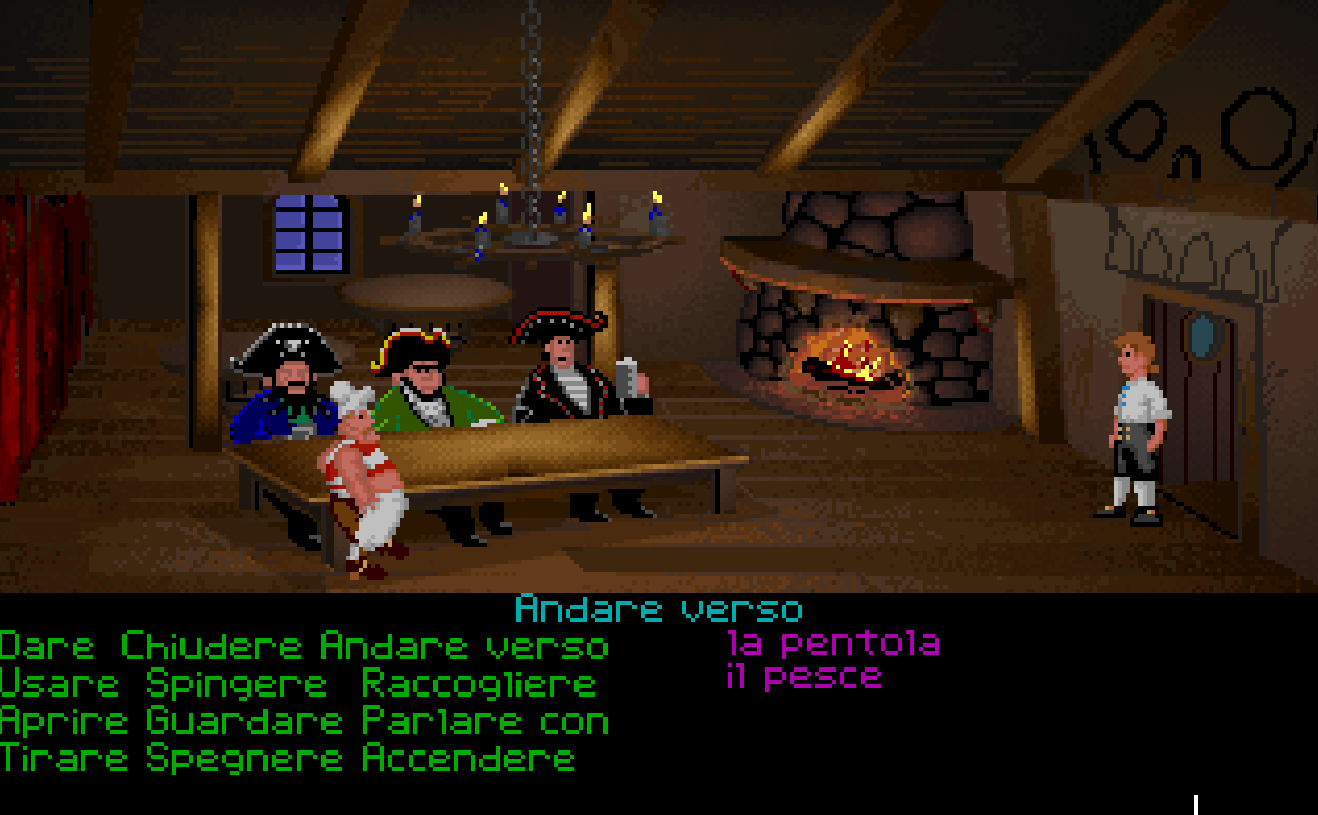
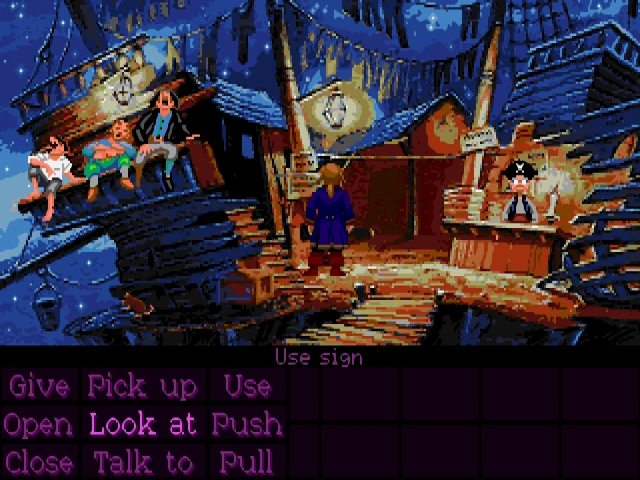
The adventures we remember, with voices to join them: LogicDeLuxe’s project brings classic Monkey Island graphics together with the Special Edition voice performances.
Voices meet pixels
What is this all about?
Some projects show just how enduring a love for an adventure can be. The Ultimate Talkie Editions grew from that passion: keeping the pixels, verbs and atmosphere of the first two Monkey Island games while letting Guybrush and his crew speak. Patient adaptation, bug fixes and careful sound work give these classics another route to sail, thanks to the dedication of their fans.
Classic-edition images from the site’s collection, not builder screenshots.
What is this all about?
The builders use the corresponding PC Special Edition files to create a voiced version for ScummVM or DOS. The small ZIP downloads are the project’s building tools, not complete games: you need to own the matching Special Edition.
Two classics, two projects
MI1 · 1.02
The Secret of Monkey Island
Version 1.02 combines Special Edition speech with the classic presentation, fixes many issues and improves sound effects. It supports MT-32, General MIDI and AdLib music, plus CD and Special Edition tracks in ScummVM, and includes an optional Spiffy close-up.
Version 0.2 is a beta. It adapts scenes and dialogue to Special Edition speech and fixes several original issues. Its readme still lists General MIDI and some sound enhancements as future work, rather than completed features.
These instructions cover the original Windows builders. The project’s historical requirements start at Windows XP; playing needs a device capable of running SCUMM V5 games, or a VGA-compatible DOS environment.
Resource
MI1 · 1.02
MI2 · 0.2 beta
Required Special Edition
The Secret of Monkey Island: Special Edition · PC
Monkey Island 2 Special Edition: LeChuck’s Revenge · PC
Keep these game files
Monkey1.pak + audio/
monkey2.pak + audio/ (Speech.xwb, Patch.xwb)
Declared disk space
About 1 GB temporary space; the project lists about 194 MB for DOS, 825 MB for FLAC or 168 MB for Ogg Vorbis.
About 1.8 GB temporary space; the readme specifies 2.6 GB for FLAC. Around 1.3 GB of intermediate WAV files may remain after building.
Additional requirement
Microsoft DirectX SDK xWMAEncode.exe, placed in tools. It is not bundled with the builder; its own licence applies.
The Special Edition must include its update and audio folder, including Patch.xwb.
Special Editions: stores and your library
The builders are free; the source games are separate. If you already own the Special Editions, retrieve the files from your library. These links open external stores.
Download the builder for your game and extract the entire ZIP, retaining its folders, tools, readme and licences.
Place the builder folder beside the Special Edition PAK file, keeping the original audio folder in place. The classic DOS game alone is not enough.
For MI1, add xWMAEncode.exe to tools. When updating an older Ultimate Talkie installation, follow the readme to remove only the previous patch, keeping your Special Edition.
Run install_flac.bat from the builder folder for lossless speech, or install_ogg.bat for smaller files. Wait for completion and check for errors.
The output is in MI1_Ultimate_Talkie_Edition or MI2_Ultimate_Talkie_Edition inside the builder. Add this generated folder to ScummVM, not the builder folder or Special Edition PAK.
In the launcher choose Add Game, select the folder, confirm the detected version and start. FLAC creates monkey.sof / monkey2.sof; Ogg creates monkey.sog / monkey2.sog.
For MI1, also set the music Extra Path. The builder creates folders such as cd_music_flac / se_music_flac or cd_music_ogg / se_music_ogg. Running extended_SE_tracks_to_game_folder.bat is optional and concerns extended ambience tracks.
MI2’s old readme mentions ScummVM 1.1.1 and a bundled modified executable. This is historical guidance: the project is now listed by ScummVM, and recent releases include Ultimate Talkie fixes. Start with the current official version and check compatibility rather than assuming that old executable is required.
Build on Windows by running install.bat from the builder folder. FLAC/Ogg is the ScummVM route; for DOS use the output prepared by this script.
Copy the entire generated folder to your DOS machine or a folder available to DOSBox. VGA and an audio configuration compatible with your chosen mode are required.
From the game directory run monkey a for AdLib or monkey r1 for Roland MT-32. MI1 also supports monkey r for General MIDI; MI2 0.2 still lists that mode as unfinished.
DOSBox example: the PC folder must already contain the generated DOS output. Replace the example path with your actual path; mounting does not build the game.
mount c "C:\UTE\MI1"
c:
monkey a
Voices, saved games and useful details
The official Special Edition voices are English. These builders do not add Italian voice acting: translated text and speech are different, and subtitle patches need their own compatibility check.
Start a new game: the readmes warn against saves from other versions. Keep your existing saves separately.
Ctrl+A toggles narrator mode; Ctrl+Q switches between original text and text matching the speech. MI1 also uses Ctrl+P for Spiffy close-up variants. The complete readme contains spoilers.
MI2 clean_up.bat removes the intermediate WAV files retained to speed up further conversions. Use it after building, following the readme.
On macOS and Linux
The official pages also link to SCUMMKit, a separate way to build ScummVM versions from owned Special Editions on macOS, Linux and Unix-like environments. The Windows and DOS instructions here describe the original builders.
Direct links to the project’s original hosted files, checked against the supplied ZIPs. Read the included readme. The patch is freeware for non-commercial use; do not redistribute the game generated from your files.
Thanks to LogicDeLuxe and the Ultimate Talkie contributors. The readmes credit Simon Sawatzki for graphics changes; MI1 also credits Mr. Coulomb and Highland Productions for musical references, and cocomonk22 for the EGA Spiffy close-up. Original games, voices and materials belong to their respective owners.
 EN ROUTE TO THE CARIBBEAN · SINCE 1999