 EN ROUTE TO THE CARIBBEAN · SINCE 1999
Names, symbols and worlds to explore
The signature of adventure
Origins
Lucasfilm, before the games
The green Lucasfilm Ltd emblem introduces the parent film company. It is the prologue, not the first independent logo of its games division.
1982
Lucasfilm Games: a new direction
The games group formed within Lucasfilm’s Computer Division in 1982. Its name linked it to the parent company while identifying another medium for imagining worlds and telling stories.
Late 1980s
The Lucasfilm Games rectangle
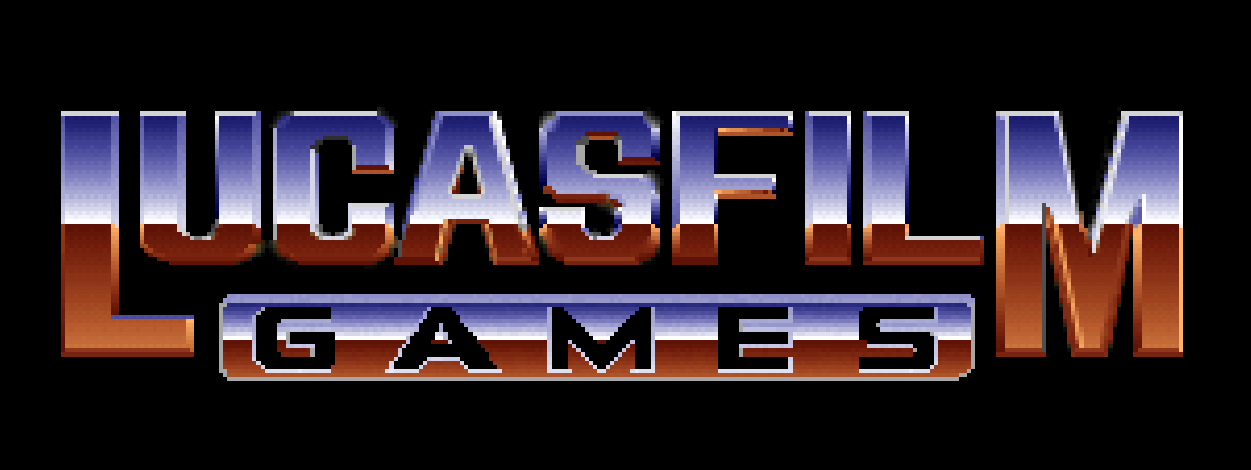
LUCASFILM sits above GAMES in a compact block, with blue, silver and orange metallic highlights. This graphic family also appears in the opening of Indiana Jones and the Last Crusade, a recognizable signature of the Lucasfilm Games era.
Lucasfilm Games period · variant date unverified
Lucasfilm Games · The marble version
The rectangular emblem has a pink and grey marble surface with small sparkles at its corners. The game and edition behind this particular variant remain unidentified.
1991 · Amiga
Monkey Island, in wood tones
The Secret of Monkey Island gives the rectangular logo a brown finish. The webmaster identifies this image as the Amiga version, released in 1991; the DOS original dates from 1990.
1990–1991
From Lucasfilm Games to LucasArts
The reorganization around 1990 introduced the LucasArts name. Monkey Island 2: LeChuck’s Revenge made the new signature familiar in 1991: a gold figure with raised arms beneath an arc of rays, standing on a purple L. The full LucasArts Entertainment Company name appears below. Corporate changes, packaging and game screens did not all change at one instant.
1992 · CD-ROM
Loom: the Gold Guy among the stars
The CD-ROM introduction places the logo against Loom’s blue star field. This identifies the pictured variant, not its presence in the original 1990 release.
1993
Sam & Max: a multiplying signature
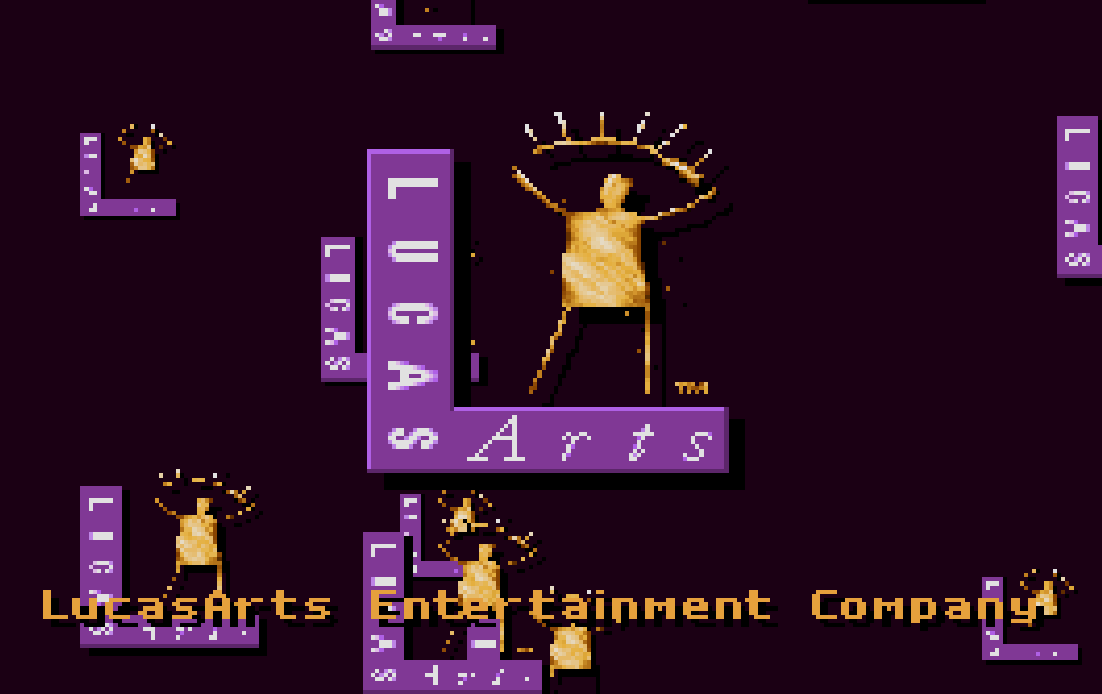
The opening of Sam & Max Hit the Road surrounds the central logo with smaller, rotated copies. The animation announces the game’s exuberant humour before the investigation begins.
1995
Full Throttle: among the clouds
The purple L and Gold Guy appear against a cloudy sky, then give way to the moving camera and the world of Full Throttle. The background and logo match the original introduction.
1995
The Dig: another sky
The Dig places the emblem against violet clouds and a bright crescent. Its opening distinguishes this variant from Full Throttle: the same year, two different atmospheres.
1990s
The classic Gold Guy
The gold figure and purple L form the classic LucasArts emblem. This flatter reproduction preserves the Gold Guy’s pose beneath the arc of rays.
1997
The Curse of Monkey Island: on the map
The logo adopts the colours and texture of an old map. The familiar signature becomes part of the Caribbean scenery and prepares us for the journey.
1998
Grim Fandango: a logo for the afterlife
The Gold Guy becomes a skeleton while keeping his pose and purple pedestal. The collected screen includes the Italian word Presenta.
2000
Escape from Monkey Island: enter the monkey
A three-dimensional monkey takes the gold figure’s place and raises a banana. The structure remains recognizable while the gag announces our return to Monkey Island.
2005
A new silhouette for the Gold Guy
The redesign rounds the figure and removes the large purple L. The gold character provides continuity; the unverified image combining the new figure and old L is not used here.
Comparison with the 2005 redesign · variant date unverified
LucasArts · The rounded figure inside the L
The rounded figure is placed beside the 2005 redesign for visual comparison. The old L means this image cannot be treated as a verified reproduction of that year’s official mark.
2013
The end of an era of internal development
LucasArts ended internal game development and shifted towards projects made with outside partners. This did not erase the catalogue or all its trademarks.
2021
Lucasfilm Games returns
On 11 January 2021, Lucasfilm announced Lucasfilm Games as the identity for its gaming titles. The original name returns in a new era of collaborations with partner studios, rather than simply reopening the old LucasArts development studio.