 EN ROUTE TO THE CARIBBEAN · SINCE 1999
Choose a port
Follow the chart or choose a stop to reach a documented encounter. These symbolic routes connect stories, not distances or popularity rankings.
Italy · Voices become memories
A line can have a rhythm and a voice that stay with you for years. Our Italian route begins with the performances in Curse and Escape, and the site’s interview with Massimo Antonio Rossi, Guybrush in the fourth game, recorded on 8 February 2001.
Founded in 1999, Monkey Island Site preserves another small part of that history through pages, pictures and messages. It is one community’s testimony, rather than a complete account of the Italian audience.
Follow this trail · Monkey Island Site · Massimo Antonio Rossi · 2001 →Monkey Island Site · 1999–2026 →The voices of the Caribbean →
Germany · Translating memories too
In his account of translating Return to Monkey Island, Marcel Weyers describes revisiting names, objects and quotations familiar to German players. He prepared a glossary of more than a hundred entries and replayed the earlier games.
His exchange with Boris Schneider-Johne, associated with the early translations, makes continuity tangible: even the name of a drink can hold a shared memory. A new translation has to find its own voice while recognising what players bring with them.
Follow this trail · Marcel Weyers · Ausflug auf die Affeninsel · 2022 ↗
Spain · A joke finds a home
Speaking to Víctor Sánchez for Neox Games, Randall A. Mage recalls translating The Secret of Monkey Island into Spanish. Playing, correcting and testing mattered: a funny solution in one scene could fail in a later one.
His example of an English plea becoming a playful Spanish expression shows why localisation recreates a comic effect. Words may change, but the character and the laugh still need to reach the player.
Follow this trail · Víctor Sánchez / Randall A. Mage · Neox Games · 2013 ↗
France · Fans behind the microphone
The French Secret of Monkey Island: Special Edition fandub website describes almost 4,500 lines and around twenty performers, according to the team’s own figures. It also introduces the people responsible for direction, technical work and mixing.
This is a fan production, separate from official releases. It shows players becoming performers and organisers to give an adventure another voice. The original project also explains that players need to own the game.
Follow this trail · The Secret of Monkey Island Special Edition · Fandub ↗
United States · An adventure enters a museum
From 16 March to 30 September 2012, The Art of Video Games at the Smithsonian American Art Museum in Washington explored games as an artistic medium. The Secret of Monkey Island was one of five playable titles, alongside Pac-Man, Super Mario Brothers, Myst and Flower.
This is a different kind of trace from a review or a personal memory: a cultural institution invited visitors to experience the relationship between images, technology and storytelling. It documents curatorial recognition, rather than American sales or audience size.
Follow this trail · Smithsonian · The Art of Video Games · 2012 ↗
Russia · Translating the alphabet too
Dragon’s Dominion’s original page documents a Russian fan translation of The Curse of Monkey Island. Version 1.1b, dated 28 August 2009, changes both dialogue resources and fonts to support Cyrillic.
Localisation also means making a language readable within the game. ENPY’s archive describes further work on text, graphics and fonts for the Special Editions and credits its collaborators. These fan projects are distinct from official translations.
Follow this trail · Dragon’s Dominion / PRCA RuSCUMM · 2009 ↗ENPY · Special Editions ↗
East Asia · Three language gateways
Return to Monkey Island’s official Steam listing includes interface and subtitles in Japanese, Simplified Chinese and Korean. These offer three ways into an adventure built around dialogue, object names and comic timing.
These entries describe written localisation; the listing does not indicate matching voice tracks. The Chinese variant is Simplified, not Traditional. Language support documents access, while local communities and reception need their own testimonies. It does not establish popularity in a country.
Three languages for reading the adventure
- Japanese · interface and subtitles
- Simplified Chinese · interface and subtitles
- Korean · interface and subtitles
Follow this trail · Steam · Return to Monkey Island · Languages ↗
Across borders · Art finds another harbour
On 31 March 2024, Legend of Monkey Island announced the return of Paco Vink’s Secret of Monkey Island comic in higher resolution. Its account credits the artist with sharing the material and Ken “Dalixam” Christensen with approving the move from The World of Monkey Island.
This stop belongs to no single country. It follows authors, readers and custodians keeping work accessible after a website closes. Remembering also means recovering, crediting and opening a door again.
Follow this trail · Legend of Monkey Island · Paco Vink’s comic is back! · 2024 ↗
The same plea, two ways to raise a smile
Randall A. Mage uses this example in his 2013 interview. The wording below follows that interview, rather than a side-by-side transcription of every game edition.
English expression citedpretty please with whip cream and a cherry on top
Spanish adaptation recalledPorfa, porfa plis recubierto de nata
The English expression piles cream and a cherry onto a pleading request. Mage describes combining a school-days mixture of “por favor” and “please” with the cream from the American expression. Literal meaning alone would not preserve that childish, persistent voice.
Follow this trail · Neox Games ↗In German, even a drink has a history
Weyers recalls Schneider-Johne’s advice to keep Malzbier for root beer. This preserves an earlier translation choice: familiar vocabulary can become part of a game’s memory.
Marcel Weyers · Return ↗A chart of testimonies, open to further journeys
These are documented examples, not a ranking or a complete atlas. Translators’ accounts, fan projects and official listings tell different stories. India, Latin America and other regions can join the route with verifiable sources and contextualised memories.
Where did you first meet Guybrush?
A floppy disk, a line in your language, a magazine shared with friends: leave a guestbook memory, with country, language and edition if you remember them. Your recollection may suggest another port to explore.
Leave a guestbook memory →Sources for the journey
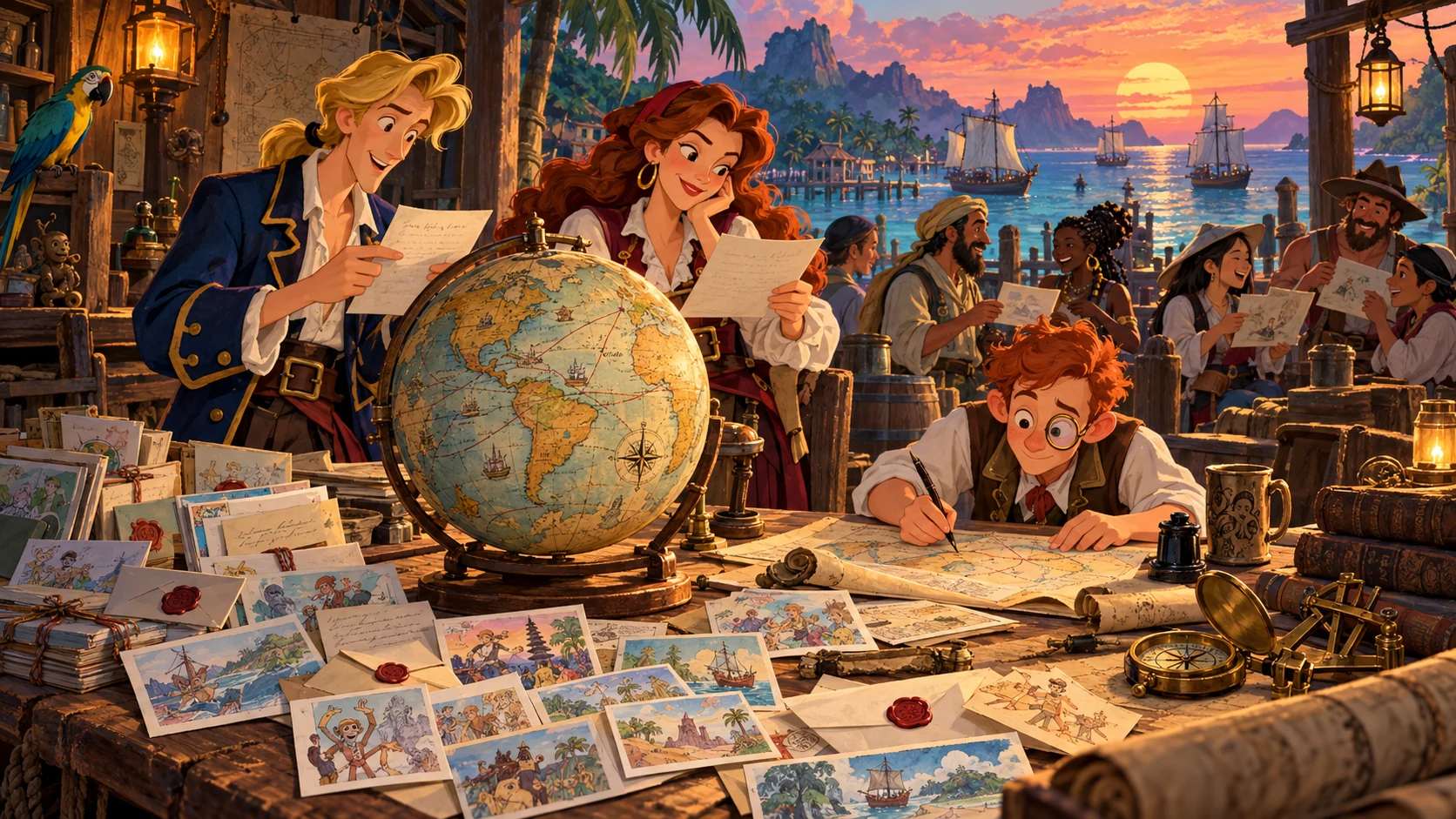
Original accounts and records are linked beside each stop. Illustrations evoke the journey; they are not historical photographs.
- Monkey Island Site · Massimo Antonio Rossi · 2001
- Monkey Island Site · 1999–2026
- Marcel Weyers · Ausflug auf die Affeninsel · 2022
- Víctor Sánchez / Randall A. Mage · Neox Games · 2013
- The Secret of Monkey Island Special Edition · Fandub
- Smithsonian · The Art of Video Games · 2012
- Legend of Monkey Island · Paco Vink’s comic is back! · 2024
- Dragon’s Dominion / PRCA RuSCUMM · 2009
- ENPY · Special Editions
- Steam · Return to Monkey Island · Languages