 EN ROUTE TO THE CARIBBEAN · SINCE 1999
The attention surrounding GTA VI brought me back to a question: what makes us grow attached to the world of a video game?
I think of those moments when we know exactly where we ought to go, but take a different road. We stop to listen to a conversation, look at a sign, enter a place simply because it intrigues us. The objective is still there. For a few minutes, it can wait.
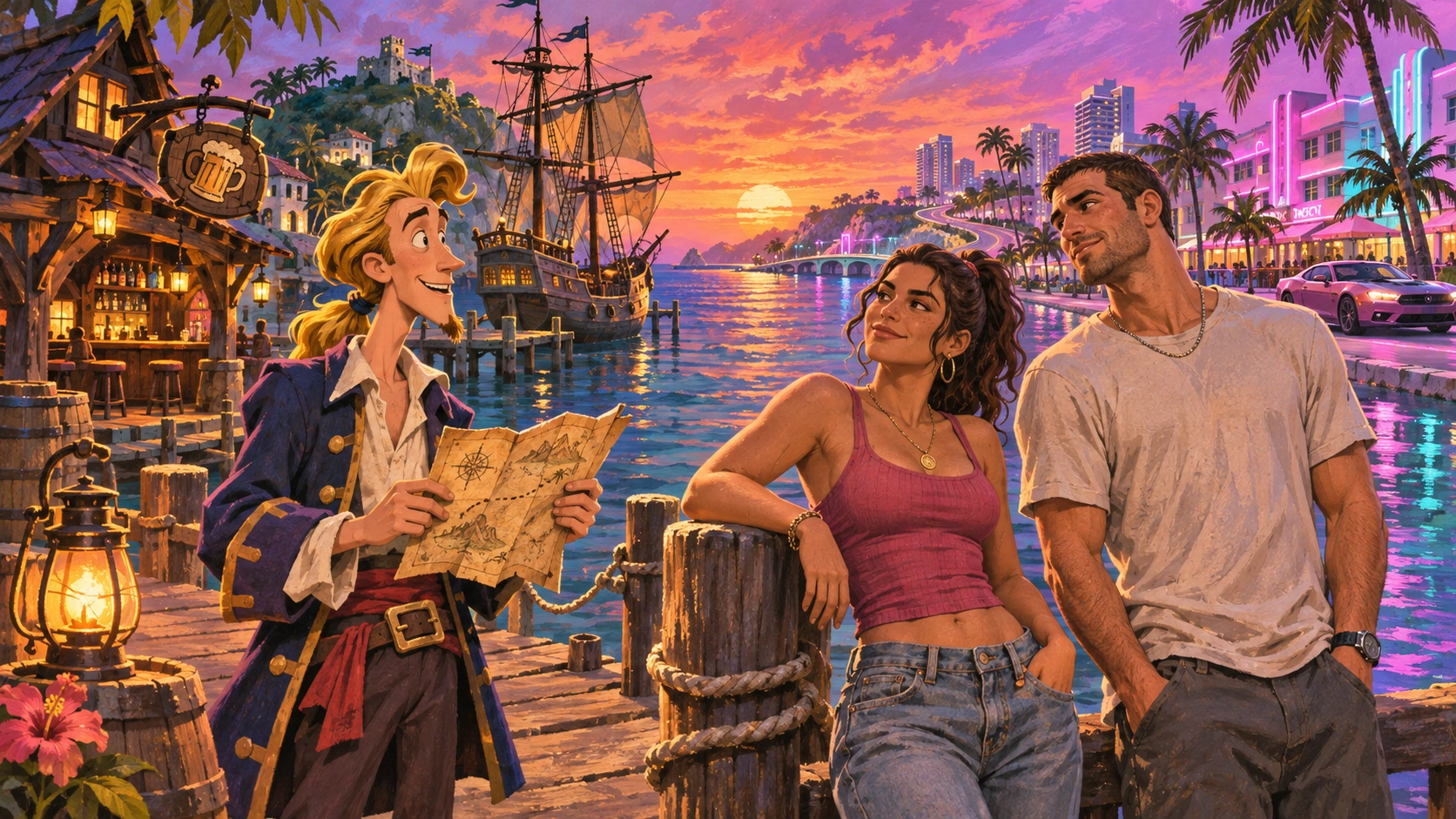
It is that feeling that makes me want to bring Monkey Island and Grand Theft Auto together.
Have I gone mad, you may wonder? I shall leave that difficult verdict to posterity…
On Mêlée we walk a handful of streets that soon become familiar. The harbour, the Scumm Bar, the store: places we can remember even when the game is not in front of us. GTA’s cities have very different dimensions, rhythms and possibilities, but they can inspire the same desire to recognise a neighbourhood, retrace a route and stay a little longer.
This is the moment that interests me: when an environment stops being merely the backdrop to a story and becomes a place where we feel we belong.
A curious connection between the two series comes from an older instalment. Grand Theft Wiki reports the line ‘You fight like a cow!’ in the underground fights of The Ballad of Gay Tony (GTA IV’s second expansion), a nod to Monkey Island’s celebrated insult swordfighting. A small trace, attributed by the community wiki, that concerns GTA IV rather than the latest, eagerly anticipated GTA VI. I like the idea that a phrase can travel between such different worlds and be recognised by people who carry both adventures with them.
There are also less obvious, but interesting, encounters. In 2009 Chris Kohler — an American journalist, author and game developer, best known as the founding editor of WIRED’s gaming section — used that very section to discuss GTA IV’s episodes and Telltale’s productions, including Monkey Island. The subject was the relationship between episodic formats, production times and satire’s ability to address the present. Two distant series thus became part of the same conversation about the future of video games.
A year earlier, in an interview with Ron Gilbert on Game Developer, Chris Remo (an American game designer, composer, writer, podcaster and YouTuber) had mentioned GTA while discussing the financial expectations attached to major productions. Gilbert agreed that games with more modest commercial goals deserved space too. I still find that thought valuable: making room for different ambitions also allows different worlds to exist.
That is where our editorial comparison begins. We can look at GTA VI’s enormous appeal while carrying with us what Monkey Island taught us to appreciate: observation, the people we meet along the way and the pleasure of spending time inside a story.
Then there is humour. Stan makes a negotiation memorable through the way he talks and flails about. In GTA, radio, advertising and characters construct a caricature of the world we travel through. In both cases, listening becomes part of exploration. A joke can make us remember an encounter as vividly as an image.
And there is music. In Monkey Island, hearing a theme again is enough to recall a place. In GTA, a radio station can change the character of a journey. They accompany us in different ways, but both can persuade us to delay our departure or take the long way round.
That is why opening a route towards GTA VI feels natural to me on Monkey Island Site. The curiosity that leads us off the familiar path is the same curiosity that keeps this site alive: returning to adventures we love and discovering that they still help us look at others.
Almost everything changes between Mêlée and Vice City. What remains is that moment when we see something, stop and think: before I carry on, I want to have a look here.
The mission can wait.
Alfnet